

Testosterone plays a major role in men’s health at every age.
It affects sex drive, erectile function, muscle mass, strength, body composition, fat distribution, body hair growth, red blood cell production, and sperm production.
Low testosterone can contribute to symptoms such as erectile dysfunction, low libido, reduced muscle mass, and weaker physical strength.
Healthy testosterone levels are not one-size-fits-all.
Testosterone varies significantly among men, so interpretation should account for age, symptoms, past baseline levels, lab reference ranges, and overall health.
Testosterone prescriptions in the UK increased by nearly 90% between 2000 and 2010, showing that more men and clinicians have been paying attention to testing, symptoms, and treatment options.
Healthy Testosterone Levels by Age
View this post on Instagram
| Age Group | Approximate Total Testosterone Range |
| 18-49 | 8.7-29.0 nmol/L / 250-836 ng/dL |
| 50+ | 6.7-25.7 nmol/L / 193-741 ng/dL |
| 20-39 | 300-1,000 ng/dL |
| 40-49 | 252-916 ng/dL |
| 50-59 | 215-878 ng/dL |
| 60-69 | 196-859 ng/dL |
| 70-79 | 156-819 ng/dL |
Broad lab ranges give a general adult framework.
Age-group ranges show how expected total testosterone levels may trend downward as men get older.
Reference tables should be treated as guides, not absolute rules.
Lab reference ranges vary by laboratory. In children and teens, ranges can also vary by Tanner stage because puberty timing has a major effect on testosterone.
Broad adult male age ranges can be useful, but population averages can be skewed by lifestyle, health status, and pre-existing conditions.
A man with obesity, diabetes, poor sleep, heavy alcohol use, or chronic illness may have levels that differ greatly compared with a healthy, active man of the same age.
Age-Specific Testosterone Levels for Younger Men

A 2022 Journal of Urology study titled “What Is a Normal Testosterone Level for Young Men? Rethinking the 300 ng/dL Cutoff for Testosterone Deficiency in Men 20-44 Years Old” examined age-specific testosterone levels in younger men.
Researchers analyzed 1,486 men ages 20-44 using 2011-2016 NHANES data. Their goal was to define more age-specific total testosterone cutoffs for younger men.
Instead of applying only one adult cutoff to all men, the study used the American Urological Association’s middle tertile definition of normal testosterone to calculate age-specific reference ranges.
Mean total testosterone across men ages 20-44 was 466 ng/dL.
| Age | Age-Specific Total Testosterone Range |
| 20-24 | 409-558 ng/dL |
| 25-29 | 413-575 ng/dL |
| 30-34 | 359-498 ng/dL |
| 35-39 | 352-478 ng/dL |
| 40-44 | 350-473 ng/dL |
Proposed age-specific low-testosterone cutoffs were:
| Age | Proposed Low-Testosterone Cutoff |
| 20-24 | 409 ng/dL |
| 25-29 | 413 ng/dL |
| 30-34 | 359 ng/dL |
| 35-39 | 352 ng/dL |
| 40-44 | 350 ng/dL |
A younger man may be low for his age even when total testosterone is above the traditional 300 ng/dL cutoff.
General Normal Testosterone Range for Adult Men
A broad adult male total testosterone reference range is about 8.7 to 29 nmol/L, or 250 to 836 ng/dL.
At peak adolescent or young adult levels, a commonly cited range is about 300 to 1,200 ng/dL.
Most UK laboratories use reference intervals similar to the broad adult range above. Still, lab ranges do not automatically account for symptoms, personal baseline levels, or age-related decline.
Ranges can differ by lab, testing method, country, and clinical guideline. A number inside a lab’s normal range also does not always mean that level is optimal for a specific person.
A man who has symptoms despite a borderline or “normal” lab result may need a more complete review of total testosterone, free testosterone, related biomarkers, health history, and treatment goals.
In that situation, working with a healthcare provider or a specialized online TRT clinic can help connect lab results with symptoms and next steps.
Clinical context matters. Activity level, overall health, symptoms, and age can all influence how adequate a testosterone level feels for a specific person.
Why Testosterone Levels Change With Age
Testosterone activity begins before birth, rises during childhood, increases sharply during adolescence, and reaches its natural lifetime peak by a man’s early 20s.
After that peak, levels usually decline gradually during adulthood.
Large blood-sample data gives a clearer view of how that decline can progress over time:
- More than 50,000 male blood samples were included in one analysis.
- Gradual decline started around age 30.
- Decline became more noticeable around age 80.
Practical age-based framing can make that pattern easier to interpret. Testosterone production often stays relatively high until a man reaches his mid-30s.
Around that point, testosterone may start falling by about 1% to 2% per year.
By age 70, average male testosterone production may be about 30% lower than peak production.
Leydig cells in the testes may decrease in number and become less responsive to luteinizing hormone, which can reduce testosterone output.
Brain signaling can also change with age. A shift in the hypothalamus and pituitary gland can affect testosterone production in several connected steps:
- Lower GnRH release can reduce pituitary signaling.
- Reduced LH signaling can give the testes less stimulation.
- Weaker testicular stimulation can lower testosterone production.
Health conditions that become more common with age can also affect testosterone regulation.
Liver disease, kidney disease, obesity, and diabetes can all influence hormone balance.
What Counts as Low Testosterone?

Many guidelines and insurers use total testosterone below 300 ng/dL as a common threshold for low testosterone.
Clinically, low testosterone is often defined as 300 ng/dL based on two blood test readings spaced a few weeks apart.
Common diagnostic factors include symptoms consistent with low testosterone, at least two low testosterone readings, and evaluation by a qualified healthcare professional.
| Symptom Category | Possible Symptoms |
| Sexual health | Low libido, erectile dysfunction, infertility |
| Energy and mood | Fatigue, low mood, irritability, brain fog, poor concentration |
| Body composition | Loss of muscle mass, increased body fat, weight gain |
| Sleep and stamina | Trouble sleeping, constant tiredness, reduced exercise or sports stamina |
| Training response | Poor workout recovery, fewer results despite similar workouts |
Symptoms can sometimes occur even when testosterone is technically inside the normal lab range.
Some men report low-testosterone symptoms even in the 400s ng/dL, despite being above the common 300 ng/dL cutoff.
Because of that, a single number should not be treated as the full answer. Symptoms, repeat labs, age, health status, and related biomarkers all matter.
Why Numbers Alone Are Not Enough
A cross-sectional cohort study of 434 men linked certain symptom patterns with different testosterone levels:
| Approximate Testosterone Level | Symptom More Likely |
| Around 15 nmol/L | Reduced energy levels |
| Around 12 nmol/L | Weight gain |
| Around 10 nmol/L | Low mood |
| Around 8 nmol/L | Erectile dysfunction |
These values are not universal cutoffs. They show why symptoms should be considered along with lab values.
A man with no symptoms at the lower end of normal may simply have a level that is normal for him.
Another man with a similar number may feel very different due to free testosterone, SHBG, sleep, stress, medication use, body fat, training load, or other health factors.
Average testosterone is difficult to define because levels can depend on health status, lifestyle, activity level, and age.
For that reason, evaluation should focus on the full clinical picture rather than only one lab value.
Free Testosterone by Age
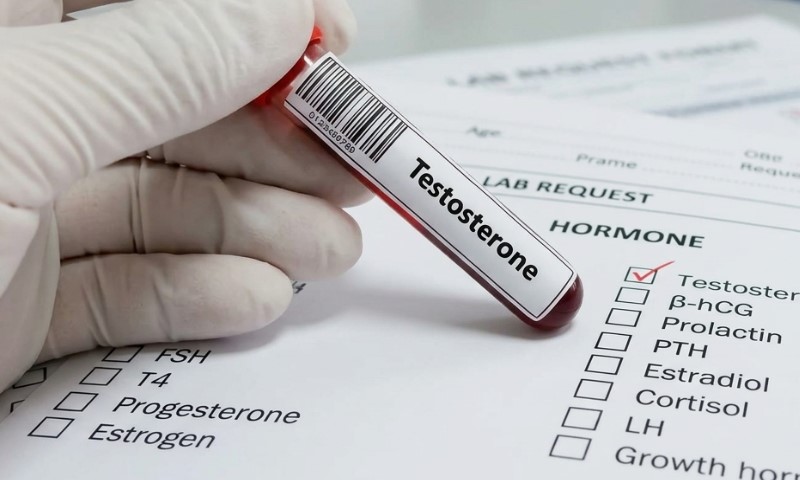
Free testosterone is the portion of testosterone readily available to cells.
Total testosterone measures overall testosterone in the blood, but free testosterone can give extra context because not all testosterone is equally available to tissues.
Free testosterone often declines with age. It may be low even when total testosterone appears normal.
Free testosterone should make up about 1% to 2% of total testosterone.
| Age | Free Testosterone Range |
| 40-49 | 5.3-26.3 ng/dL |
| 50-59 | 4.2-22.2 ng/dL |
| 60-69 | 3.7-18.9 ng/dL |
| 70-79 | 2.2-14.7 ng/dL |
Total testosterone, free testosterone, and bioavailable testosterone can each add different information. Total testosterone alone may not tell the full story.
SHBG, albumin, and other biomarkers can affect how much testosterone is available to tissues.
Two men with similar total testosterone may feel different if one has much lower free or bioavailable testosterone.
Free testosterone can be especially helpful when symptoms do not match total testosterone results.
It can also help clinicians evaluate men with high SHBG, obesity, aging-related hormone changes, or health conditions that affect hormone binding.
Closing Thoughts
Healthy testosterone levels are best viewed as part of a bigger clinical picture rather than as a single number on a lab report.
Age, symptoms, overall health, lifestyle, and the type of testosterone being measured can all affect how results should be interpreted.
For that reason, symptoms such as low libido, erectile dysfunction, fatigue, mood changes, reduced strength, and poor workout recovery should be taken seriously.